Hollywood Bowl: Soul of a City
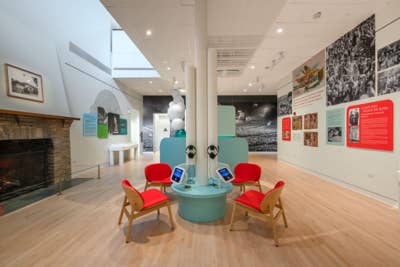
Welcome to the Hollywood Bowl Museum’s permanent display. The artifacts and narrative vignettes presented in this exhibition are tied together by five interlocking themes. This is equally a story of a beloved Los Angeles park, the people who built it and continue to care for it, a deep-seated community-building ethos, and making music that emanates from the Bowl’s stage to audiences all the way up in the last row. Finally, Hollywood Bowl’s distinct visual appeal unifies all aesthetic elements—architectural style, light, form, design, landscape, proportion, and more—to enhance emotional connection and enjoyment of this venerable LA venue. These five threads remain constant even as music tastes, the landscape, and Los Angeles continue to evolve.
Ljiljana Grubisic, Curator
Photo credit: "Hollywood Bowl: Soul of a City" exhibition , 2026. Photo by Elif Karakoc, LA Phil Archives.
Founding of a Civic Institution
The Hollywood Bowl was born at a moment when Los Angeles was rapidly reinventing itself. During the 1920s, the city expanded at extraordinary speed, shaped by an oil boom, real estate speculation, the rise of Hollywood, new industries, and waves of new residents arriving from across the country.
Amid this transformation, a remarkable coalition of Angelenos came together around an ambitious idea: to create a public outdoor arts venue unlike anything else in the United States. The Bowl’s founders represented an unusually wide cross-section of civic life. They included musicians, dancers, educators, doctors, philanthropists, business leaders, social reformers, filmmakers, and real estate developers. Some saw the arts as a way to educate and unify the public. Others believed a great cultural institution could help define Los Angeles as a world-class city.
Together, they imagined the Bowl as more than a performance venue. It was conceived as a public gathering place—a democratic space where music, art, and community could be shared under the open sky.

Hollywood Bowl is a Public Park
The Hollywood Bowl is more than a world-renowned music venue. It is an 88-acre public park, owned by the people of Los Angeles County and open year-round for all to enjoy.
Long before music filled the canyon, this hillside, then known as Daisy Dell, was already a place where Angelenos came to gather. Visitors spread out blankets, shared meals, and lingered in the natural amphitheater, drawn by its beauty, accessibility, and the way sound seemed to carry effortlessly through the hills.
More than a century later, the Bowl remains both a cultural landmark and a living park. Nearly half of its grounds are preserved as biodiverse landscape, home to three ecosystems: coastal sage scrub, mixed chaparral, and sumac shrub. The natural setting that first drew visitors continues to shape the experience of the space today.

Peppertree Lane
Leading to the Hollywood Bowl Museum, Peppertree Lane traces one of the site’s earliest pathways. Once known as Bolton Road, it was lined with South American pepper trees—planted in the 1920s to help “emparadise” Los Angeles.
A local legend suggests that early fence posts along the lane took root and grew into trees. While most of the original trees were lost to disease by the 1950s, one remains near the Museum entrance. New trees planted in 1997 continue this legacy, offering visitors a glimpse of the Bowl’s early landscape.

Green Initiatives
Learn about our commitment to preserving the beauty and conserving the natural setting of the land now called the Hollywood Bowl.

The Shape of an Icon: The Hollywood Bowl Shells
When symphonic concerts began at the Bowl in 1922, there was no permanent shell. The first stage was a simple wooden platform with a canvas roof held up by columns designed mainly to keep musicians out of the sun. But as audiences grew, so did ambition for a more permanent structure.
But the Bowl’s iconic shell was not the result of a single grand plan. It emerged through years of experimentation, debate, and trial–and-error as architects, engineers, and Bowl leaders searched for the right balance between beauty and sound.
Between 1926 and 1929, the Bowl leadership commissioned four dramatically different shells in rapid succession. Each attempted to solve a difficult question: what should the Hollywood Bowl look—and sound—like?
This exhibition includes a 2026 video interview with Craig Hodgetts and Hsinming Fung discussing their role in the design of the current Hollywood Bowl shell
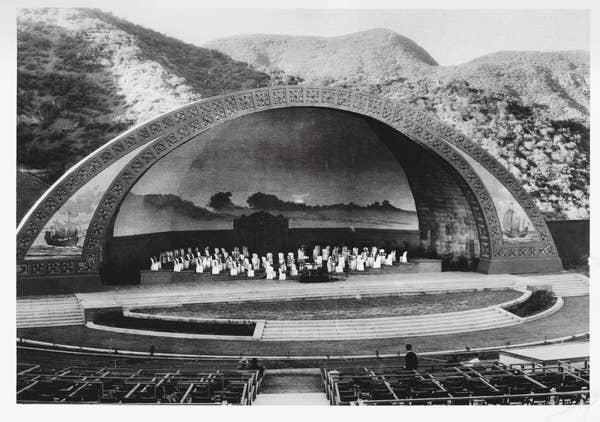
1926
The first true shell was created by Allied Architects, a coalition of Los Angeles firms that included Pasadena architect Myron Hunt, designer of the Bowl’s amphitheater seating. The structure introduced a large arched proscenium that framed the stage while preserving views of the surrounding hills.
But there was a problem. Recent grading and expansion of the hillside had altered the canyon’s natural acoustics, and the new shell unintentionally blocked much of the sound resonance audiences had previously enjoyed. Though visually striking, the shell failed acoustically and was dismantled after a single season.
Photo credit: Hollywood Bowl shell, 1926. LA Phil Archives.
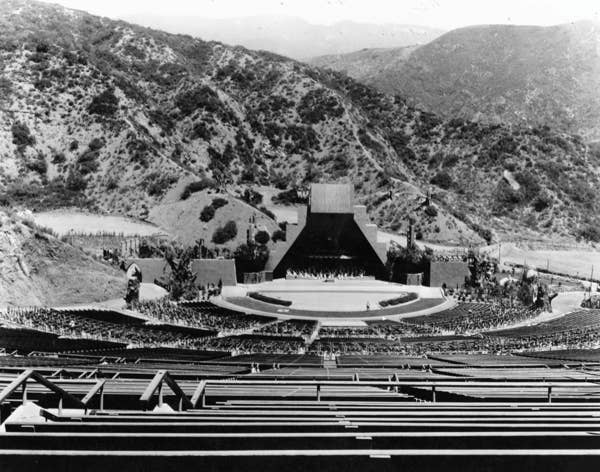
1927
The following year, architect Lloyd Wright (1890-1978), the son of Frank Lloyd Wright, proposed something radically different: a pyramid-shaped shell built from discarded wood left over from the Pickford-Fairbanks Studios production of Robin Hood. Constructed in just 10 days for $1,500, Wright’s bold structure was widely praised for its acoustics. Many believed it produced the best sound Bowl audiences had ever heard.
Yet the shell’s avant-garde appearance proved divisive. To some Bowl leaders, the dramatic pyramid looked too modern and unconventional for a civic music venue. Despite its acoustic success, it lasted only one season.
Photo credit: Hollywood Bowl shell, 1927. LA Phil Archives.
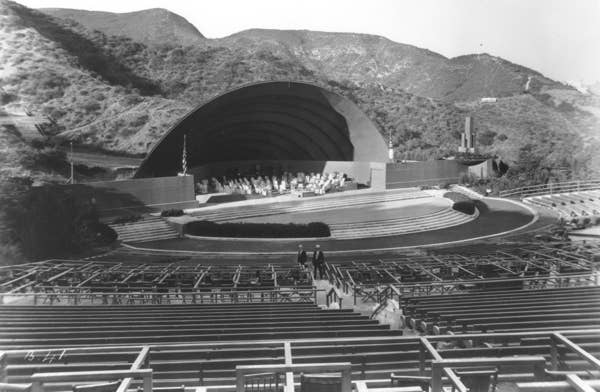
1928
Wright returned the next year with a new approach—one that would change the Bowl forever. His second shell featured a series of sleek concentric arches that could be acoustically adjusted panel by panel. Elegant, modern, and visually striking, the design aligned with the emerging Streamline Moderne movement.
For the first time, the Bowl had found a form that united acoustics, architecture, and identity. The concentric arches quickly became synonymous with the Hollywood Bowl itself.
Photo credit: Hollywood Bowl shell, 1928. LA Phil Archives.
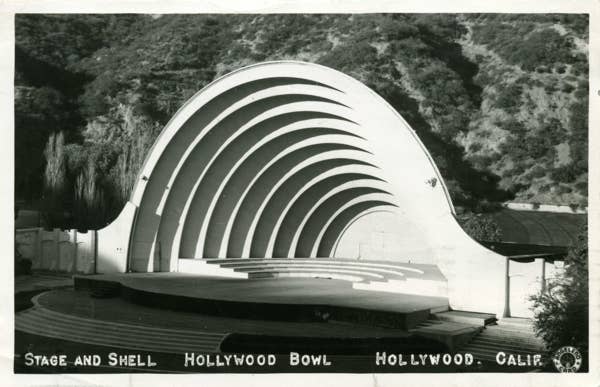
1929
In 1929, engineering firm Elliott, Bowen, and Walz refined Wright’s concept into a larger semi-circular shell constructed from Transite, a mixture of concrete and asbestos, stretched over airplane steel. Built in just three months, the 55-ton structure sat on rails so it could be moved behind the hillside when not in use.
The shell was intended as a temporary solution. Instead, it became the defining image of the Hollywood Bowl for nearly a century.
Photo credit: Hollywood Bowl shell, 1929. LA Phil Archives.
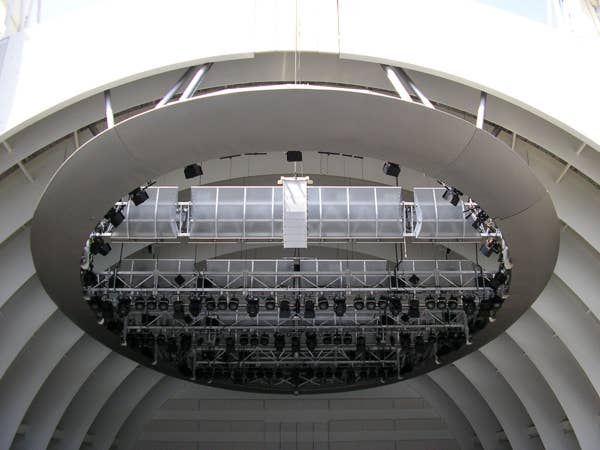
2004
The fifth shell in the history of the Hollywood Bowl was designed by the architectural firm Hodgetts + Fung. Their design improved functionality, brought the venue up to current safety, electrical, and seismic standards, transformed the shell’s acoustics while expanding the performance space by 30 percent compared to the 1929 version it replaced. The shell also provides built-in support for lighting and visual effects equipment and includes a custom-designed rooftop catwalk that simplifies staging for the Bowl’s fireworks tradition, which dates back to 1969.
One of the project’s most innovative features was the adjustable acoustic halo suspended from the ceiling. Carefully integrated into the shell without obscuring its famous arches, the halo is constructed from industrial and aircraft-grade aluminum and fitted with 27 computer-controlled adjustable louvers. The system enables musicians to hear one another more clearly while also enhancing sound projection, allowing performances to reach audiences as far as 450 feet away in the Bowl’s stage.
Photo credit: Bowl shell with orchestra on stage, 2021. Photo by Dustin Downing.
Gathering at the Bowl: The Tea Room and Tea Garden
The ground beneath today’s Hollywood Bowl Museum has welcomed concertgoers for more than a century. Long before this building existed, visitors gathered here to dine, socialize, and meet artists under the pepper trees before performances began.
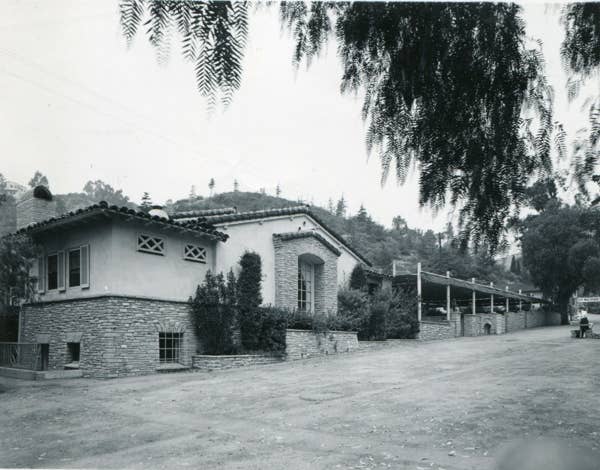
Tea Room
The Tea Room, constructed in 1939 with federal funding from the Works Progress Administration (WPA), was a single-level stone-and-stucco structure designed to resemble a small house. It featured a large bay window overlooking Peppertree Lane and a prominent interior fireplace. The Tea Room could accommodate approximately 100 guests for indoor dining, while the adjacent outdoor Tea Garden offered seating for an additional 600 visitors, providing a relaxed setting for patrons before concerts at the Hollywood Bowl.
Photo credit: Tea Room exterior, ca. 1940s. LA Phil Archives.
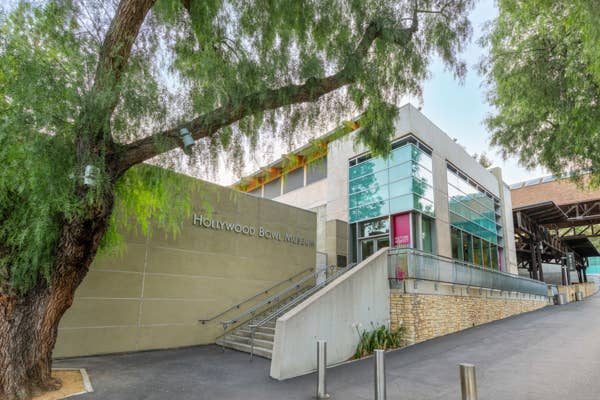
Hollywood Bowl Museum
The Tea Room remained in its original form and function until 1984, when it was converted into the Hollywood Bowl Museum in time for that Summer Olympic Games in Los Angeles. The museum occupied the historic structure until 1995, when the building was demolished to make way for a redesigned, two-story facility. The new museum opened in 1996, coinciding with the 75th anniversary of outdoor music at the Bowl. It was named the Edmund D. Edelman Hollywood Bowl Museum in honor of the Los Angeles County Supervisor at the time, who played a key role in its creation.
Photo credit: Hollywood Bowl Museum, 2023. Photo by Elif Karakoc, LA Phil Archives.
Tea Garden
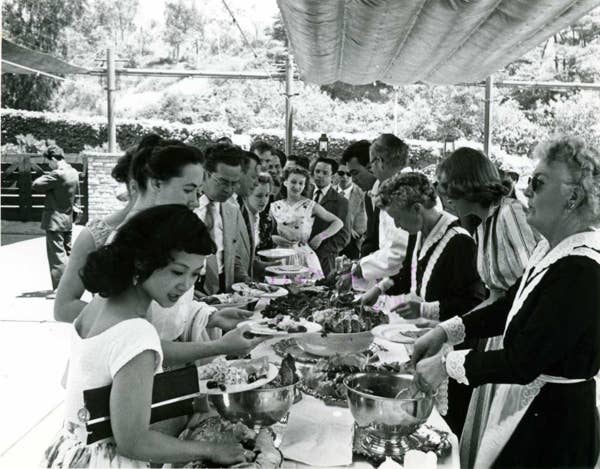
The Tea Garden, which opened in 1923, offered simple fare such as sandwiches, ice cream, and coffee. It also served as a lively gathering place for meetings organized by the Bowl’s volunteer committees.
Among its most popular recurring events were the Artists’ and Conductors’ Breakfasts, held every Tuesday morning at 8 a.m., from 1928 and until 1944, and personally overseen by Florence M. Irish (1889-1971). Open to the public for a nominal fee, the breakfasts offered music enthusiasts a rare opportunity to interact with prominent conductors and performers.
Photo credit: Diners in line at the Tea Garden, ca. 1957. Photo by Otto Rothschild. Courtesy of The Music Center.
From Experimentation to an Icon
The Hollywood Bowl emerged during the rise of Art Deco, the bold international design movement associated with glamour, ornament, and modern life between World War I and II. But the Bowl ultimately came to embody a more restrained variation of that style: Streamline Moderne.
Emerging during the Great Depression, Streamline Moderne simplified the lavish decoration of earlier Art Deco into smooth curves, clean lines, and aerodynamic forms that suggested efficiency, movement, and optimism.
The Bowl’s Streamline Moderne identity was completed in 1940 with the unveiling of the Muse of Music, Dance, Drama fountain at the entrance to the grounds. Designed by sculptor George Maitland Stanley (1903-1970)—best known for creating the Oscar statuette—and funded through the Works Progress Administration, the monument announced the Bowl’s arrival as both a civic landmark and a cultural destination.
Rising 40 feet high, the fountain combines classical symbolism with the sleek geometry of Streamline Moderne design. Together with the iconic shell, it helped define the visual identity of the Hollywood Bowl for generations to come.

Hollywood Bowl Volunteers
The Hollywood Bowl was, from its earliest days, a collective cultural enterprise sustained by an army of devoted, unpaid supporters. These volunteers participated in a wide range of activities, from fundraising campaigns such as “penny banks” to ushering concerts, selling tickets, cultivating public support, and expanding audiences throughout Los Angeles. Most of them were women. Their contributions were essential not only to the Bowl’s early success but also to preserving its cultural legacy.

Tearsheets and Scrapbooks
Since the inaugural season, the Bowl volunteers assembled large bound folio volumes and filled them with newspaper clippings, often layered atop one another, a visual testament to the sheer volume of coverage the Bowl received. In doing so, they effectively formed the backbone of early public relations efforts.
Tearsheets documented the instances in which the Bowl was mentioned in print, functioning as the LA Phil’s official record of announcements and media coverage. In contrast, scrapbooks provided a richer and more personal account. Besides photographs and event invitations, these elaborate and often ornate albums captured decades of concert life, preserving programs, administrative memorabilia, fundraising cards, handwritten notes, decorative embellishments, and records of the neighborhood committees that supported both the Bowl and the LA Phil . Some of these materials date back to the founding of the first Women’s Committee in 1923.
The LA Phil Archives holds a collection of 38 tearsheet books (1945–66) and 90 scrapbooks (1922–84).
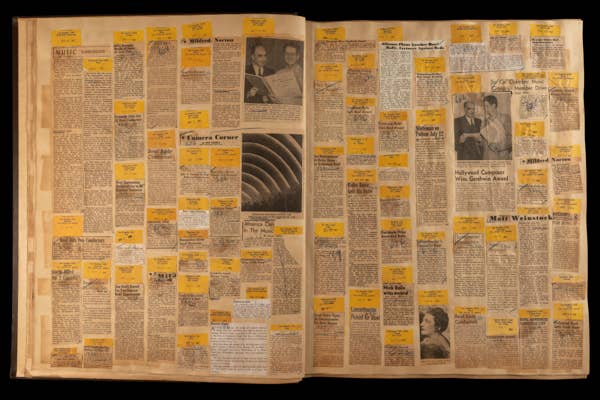
Hollywood Bowl volunteers scrapbook, 1947. LA Phil Archives.
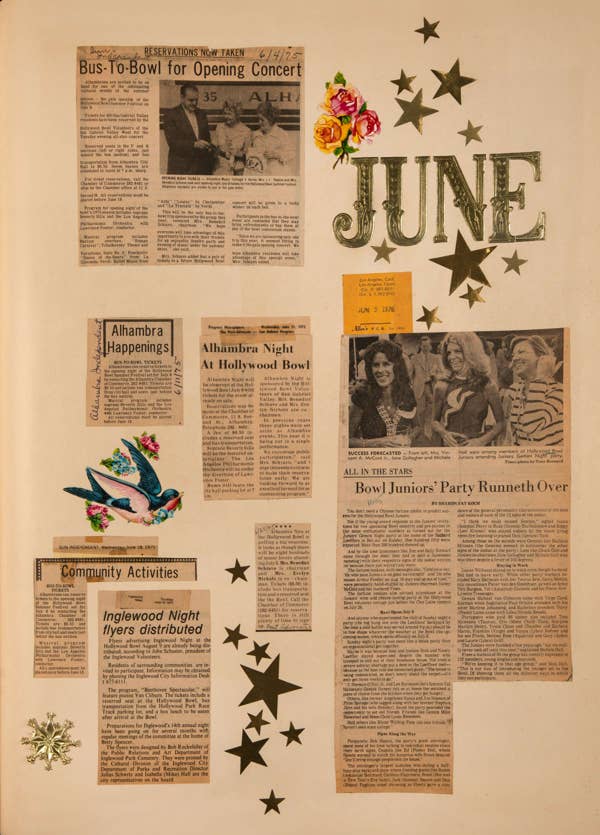
Page from Hollywood Bowl volunteers scrapbook, June 1975. LA Phil Archives.
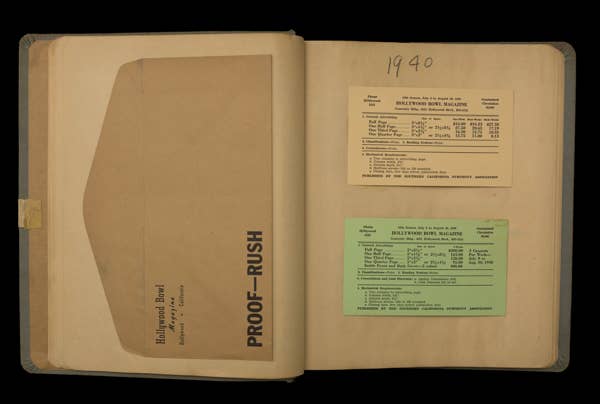
Hollywood Bowl Magazine advertising rate cards and envelope, 1941. LA Phil Archives.
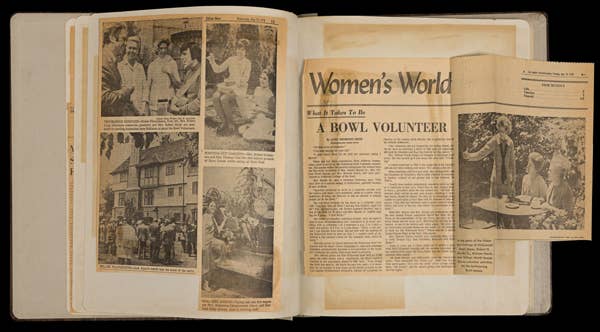
Hollywood Bowl volunteers scrapbook, 1970. LA Phil Archives.
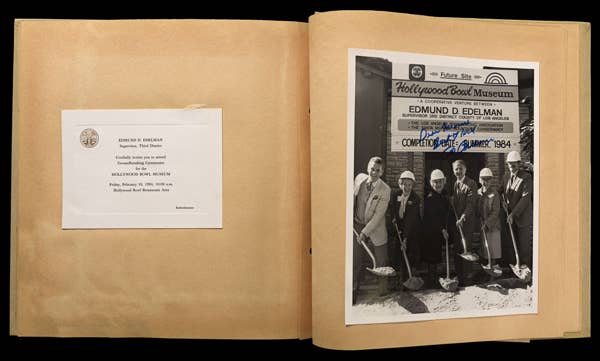
Invitation and signed photo from Hollywood Bowl Museum groundbreaking ceremony, 1984. LA Phil Archives.
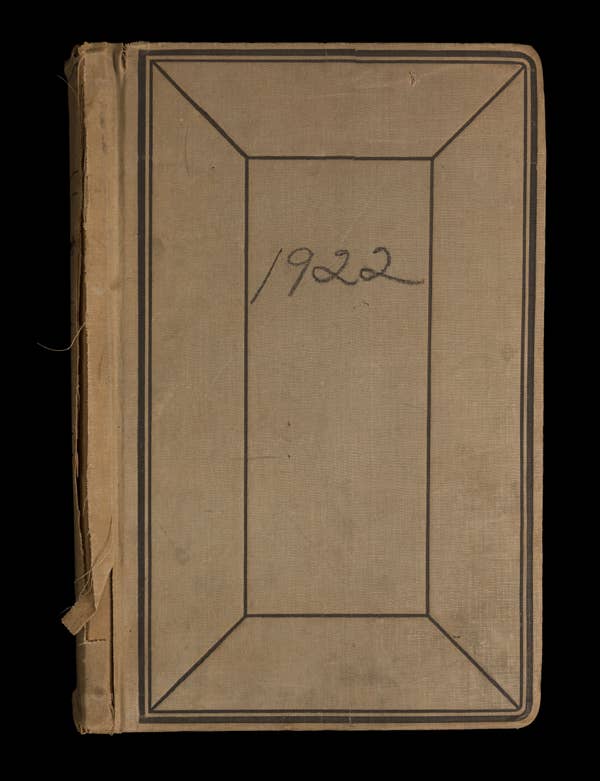
Cover of Hollywood Bowl volunteer scrapbook, 1922. LA Phil Archives.
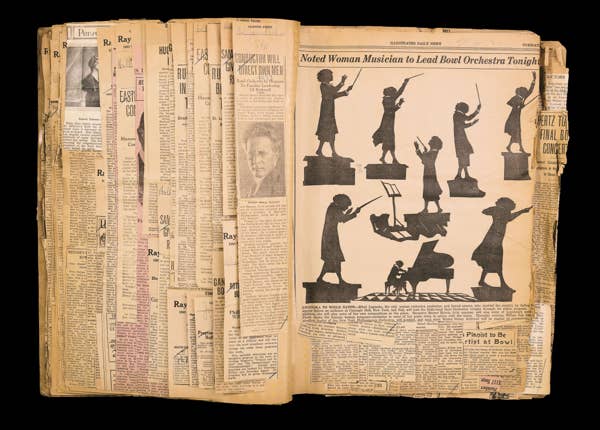
Hollywood Bowl press clippings scrapbook, 1925. LA Phil Archives.
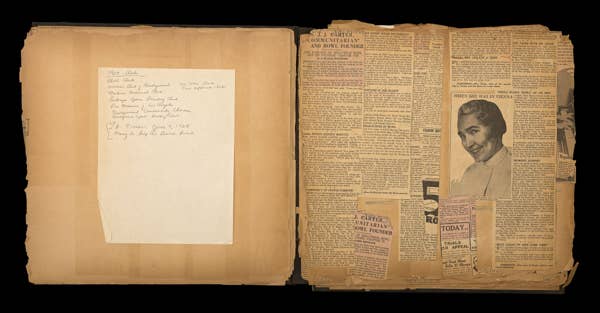
Hollywood Bowl volunteer scrapbook, 1929. LA Phil Archives.
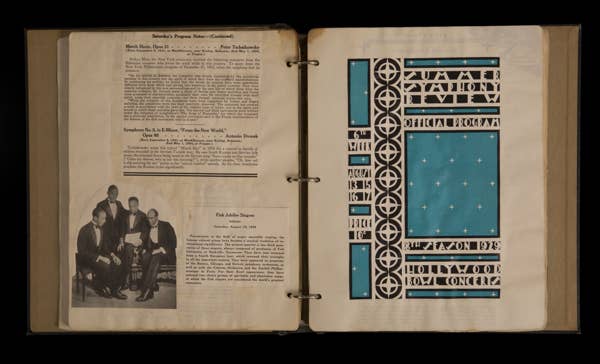
Hollywood Bowl regular season scrapbook, 1924-32. LA Phil Archives.
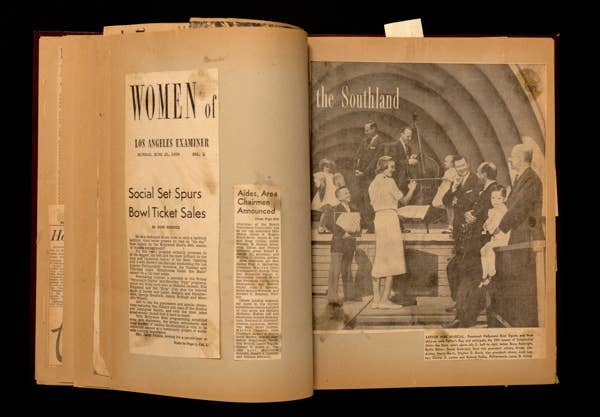
Hollywood Bowl volunteer scrapbook, 1958-1959. LA Phil Archives.
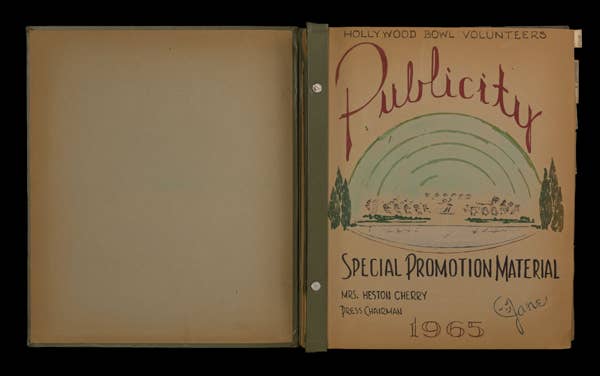
Illustrated Hollywood Bowl volunteers scrapbook cover, 1965. LA Phil Archives.
Visit the Museum
FREE admission all year
Touring the Bowl may be closed on specific days. Guests wishing to include a museum visit in their itinerary should contact the museum directly or our Audience Services team for further information.
-
Location
2301 N Highland Ave, Los Angeles, CA 90068
The Museum is located at the bottom of Peppertree Lane—the first building on the right when entering from Highland Avenue.
-
Summer Hours
(June–September, exact dates variable by season)
Tuesday–Friday: 10AM - show time
Saturday-Monday: 4 hours prior to show time -
Off-Season Hours
(Mid–September through June, exact dates variable by season)
Tuesday–Friday: 10AM - 5PM
Saturday–Monday: closed
Closed: Thanksgiving Day, Christmas Day, and New Year's Day


